


07.30.2025
By uscbknpt
Practicing What They Preach
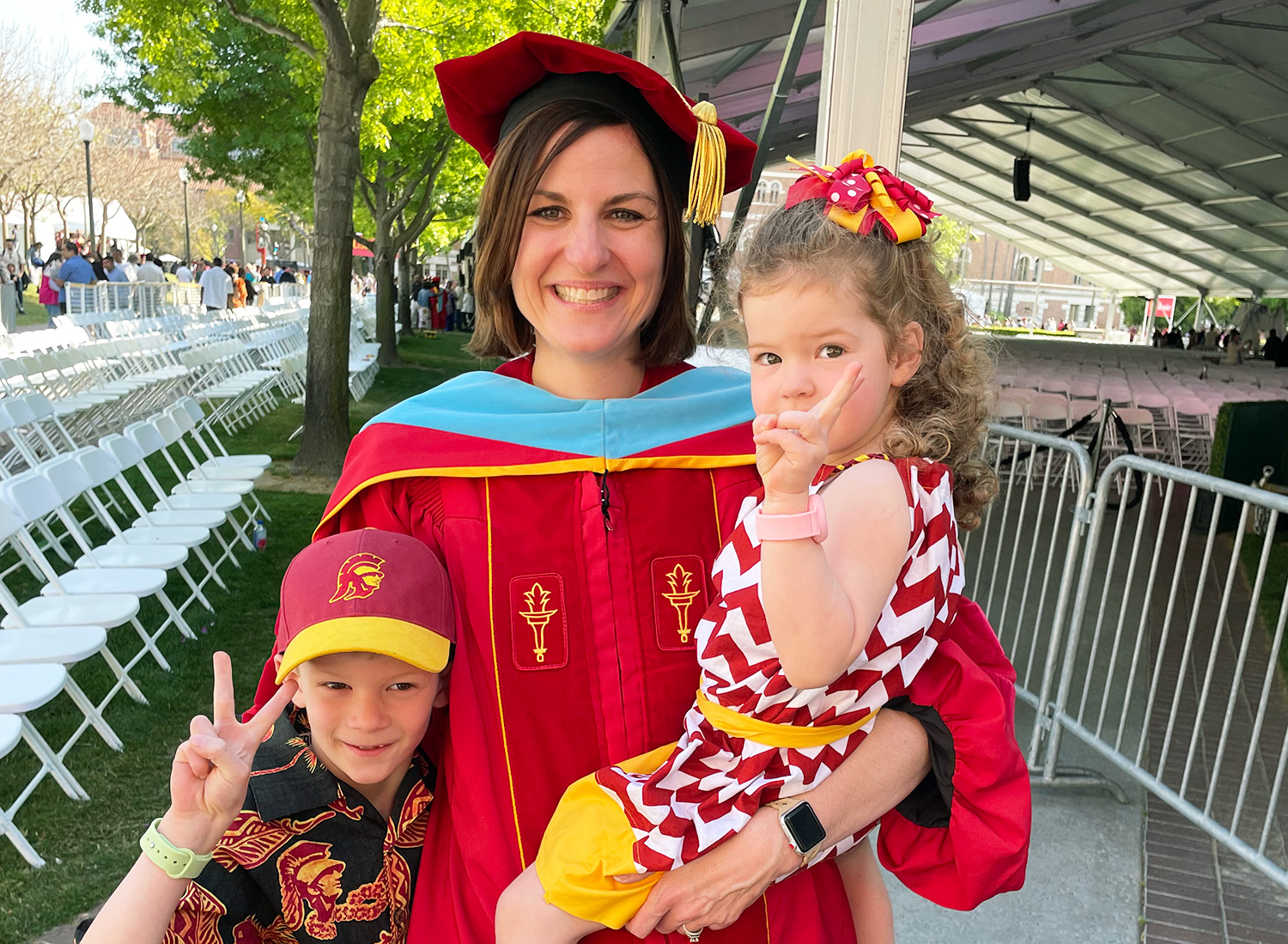
In pursuing their own academic doctorate degrees, three seasoned USC DPT faculty members (including Elise Ruckert, pictured above with her two children) model lifelong learning and continuous personal improvement.
BY DANIEL P. SMITH
TO BE CLEAR, Didi Matthews ’99, DPT ’02 didn’t have to pursue her doctorate degree.
A faculty member of the USC Division of Biokinesiology and Physical Therapy since 2002, Matthews had built an impressive curriculum vitae over the previous two decades, certainly enough to continue thriving in academia.
A board-certified neurologic clinical specialist, Matthews brought her expertise to the doctor of physical therapy (DPT) program classroom, earning awards for teaching and mentorship. She published papers in peer-reviewed journals and delivered presentations at national conferences. She enthusiastically tackled new administrative roles, such as serving as the director of the Division’s Institute for Excellence in Teaching (DIET) as well as vice chair of culture, community and health equity.
Time and again, Matthews demonstrated her commitment to the profession, USC and its DPT students. Simply maintaining that pace would have been enough, but Matthews, energetic and enterprising, isn’t much for complacency. She values continued intellectual growth.
“I’m a curious person, and constantly learning is one of my top priorities,” Matthews says.
In 2023, Matthews enrolled in the organizational change and leadership EdD program at the USC Rossier School of Education. While retaining all of her existing USC academic, research and administrative responsibilities, Matthews dove into a doctorate program designed to help individuals drive innovation and systemic transformation in organizations.
“I’m trained as a physical therapist, not an educator or administrator, so putting myself in this program was a way to gain the theoretical knowledge and technical experience to guide organizational change and contribute to the Division’s ongoing success,” says Matthews, who is on track to complete her EdD program later this year.
Other Division faculty share Matthews’ hunger to access new knowledge and strengthen capabilities. Together, they personify the lifelong learning aspect long championed by the USC DPT program.
Higher learning
Last year, Elise Ruckert EdD ’24, a former neurologic physical therapy resident at USC (2007-2008), earned an EdD in organizational change and leadership from USC Rossier.
Soon after returning to USC in 2019 as an associate professor of clinical physical therapy, Ruckert entered USC’s EdD program to gain more educational research training, particularly around qualitative and quantitative research methods. She also desired more formal training around leadership, communications and scholarly writing. It was a carefully constructed plan to expand her mind and elevate her career.
As Ruckert studied human learning in her EdD program, she simultaneously incorporated theories of learning, motivation and change management into the DPT classes she was teaching. She also shared new knowledge with colleagues when leading faculty chats hosted by DIET or developing new projects with the Educational Scholarship and Research Lab.
“I engaged in so many tough but important conversations to understand how I could better help students and colleagues move forward in productive ways,” says Ruckert, who completed her degree while juggling pandemic upheaval, full-time faculty duties and parenting two young children.
This summer, Julie Tilson DPT ’98, MS ’09, DPT program director and professor of clinical physical therapy, earned her PhD by prior publication through Kingston University in London. The unique program allows established scientists with multiple years of significant productivity on a common theme to pursue a PhD, albeit with a strict one-year timeline.
Tilson transformed seven first-author papers over the past decade into her thesis, which focused on the integration of research evidence into clinical practice patterns and behavior. For Tilson, compiling a decade of scientific work into one cohesive, theory-driven story forced reflection, analysis and learning well beyond her expectations.
“The process was more intense and educational than I ever anticipated. I gained deeper perspective of both my past work and on my next steps as a scientist,” says Tilson, who also serves as the associate chair of DPT education at USC.
With support from family, intrinsic determination and steady encouragement from USC colleagues like former associate dean and DPT chair Jim Gordon, who encouraged Tilson to secure credentials matching her capabilities, Tilson completed her thesis in five months and defended it in April.
The benefits of lifelong learning
Matthews credits her EdD studies for illuminating the theoretical underpinnings behind organizational change and leadership. It has helped her bring enhanced purpose to her USC duties and spurred a focus on transparency, which she considers vital to leadership in a fluid, fast-evolving academic landscape.
“Being as transparent as possible ultimately allows more ideas to come to the surface, heightens trust and fosters a collective journey,” Matthews says. “I see that now more than ever.”
Inspired by her EdD work, Matthews says she evaluates past and current efforts with fresh eyes, which has empowered her growth as an academic professional.
“I’m not thinking about what feels good in my gut but creating sound justification for programs or policies I’m considering myself or with colleagues,” says Matthews, who was promoted to professor of clinical physical therapy earlier this year.
In pursuing her EdD, Ruckert discovered her scholarly agenda — the faculty belonging experience — but, even more, a heightened sense of her own belonging in academia. Continuing her learning and earning the EdD provides credibility and unlocks professional opportunities beyond her current roles, which include directing the USC DPT Mentor Program and chairing the Educational Scholarship and Research Lab.
“Before, I was a physical therapist first and an educator second. Now, I am a leader in education first and a very proud physical therapist second, both of which are critically important to my professional goals,” Ruckert says.
For Tilson, who boasted nearly 20 years as a research professor, the greatest value of earning the PhD rests in what it communicates to her USC students.
When Tilson received official word of her PhD completion from Kingston University on the morning of June 3, she went to class at USC and shared the news with her students. She then signed her name on the whiteboard followed by her newly earned credentials for the first time.
“It models for students that we’re never done learning and can always be growing,” Tilson says. “Our students expect the best from us and that means always evolving to bring them even greater value. When we’re lifelong learners our-selves, we are prepared to accomplish that commitment.”