


05.15.2026
By uscbknpt
Soldier On
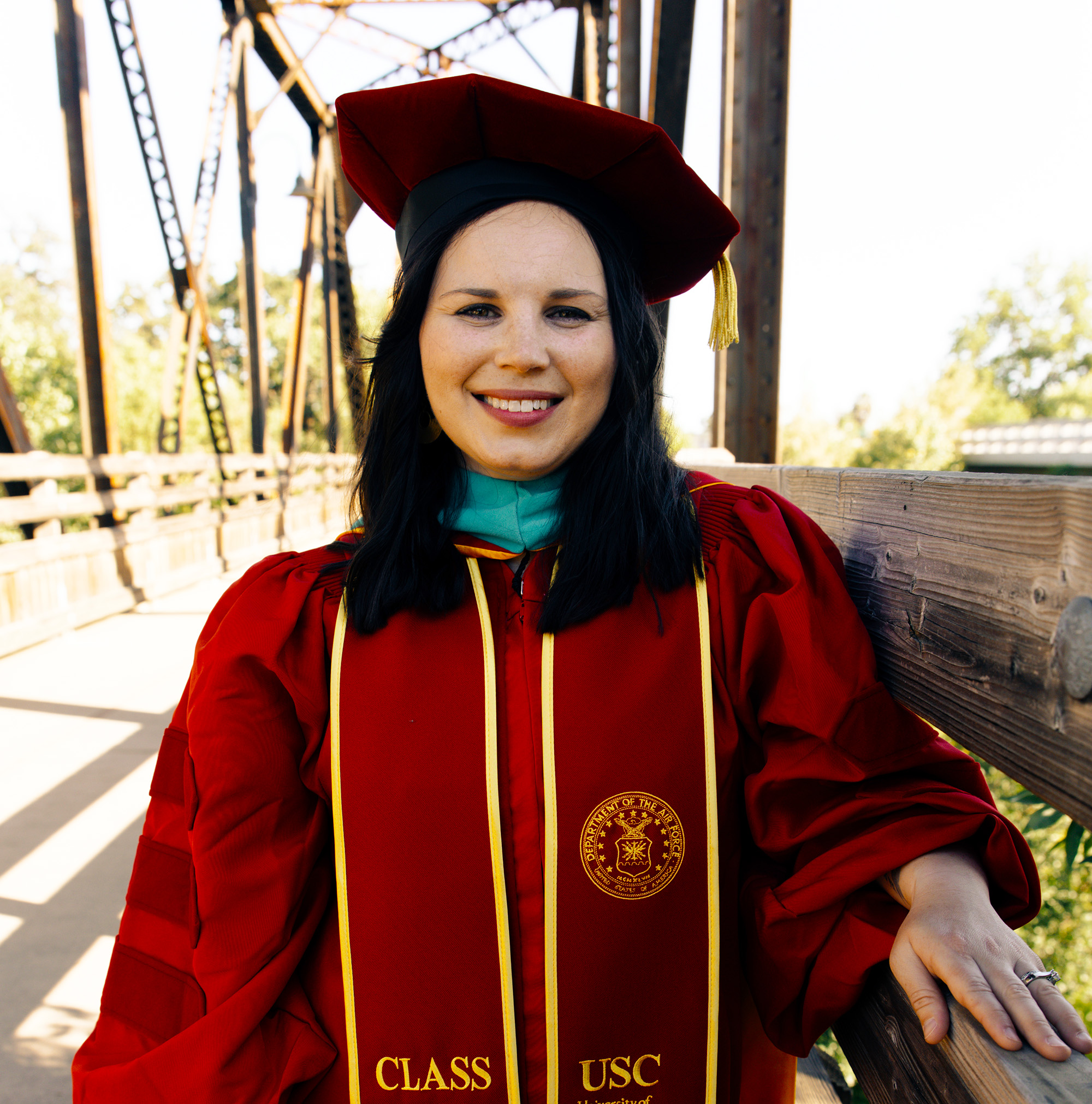
With a military background that strengthened her resolve to pursue a career in physical rehabilitation, Alicia Correa now has the education to make a real impact in the physical therapy profession.
BY JAMIE WETHERBE MA ’04
FROM A YOUNG AGE, Alicia Correa DPT ’26 wanted to join the military.
“Initially, I wanted to become a fighter pilot,” says Correa, who grew up in Ocala, Fla. “However, the more I became involved in the medical field, the more my interest changed,” she says.
Correa joined the U.S. Air Force in 2010 and shifted her focus to emergency care, serving as a medical technician on active duty and in the reserves. “I worked with service members dealing with both physical and mental injuries,” she says. “That experience helped shape my clinical awareness and empathy.”
While stationed in Germany, Correa was first inspired to pursue a career in physical therapy. As a volunteer with the Wounded Warrior Project, she assisted at transition centers that coordinated care for wounded soldiers awaiting evacuation.
“At the time, my role involved transporting critically injured service members across the world,” she says. “I often found myself wondering what life would look like for them after such significant injuries.”
Correa observed the critical role physical therapists played in rehabilitation and recovery, working directly with patients to regain mobility, strength and independence.
“Some were even able to return to military service, which was incredibly powerful to witness,” she says. “It showed me that there was a field dedicated to helping people not just survive, but truly live again.”
A First-Generation Milestone
Correa’s decision to pursue physical therapy marked a significant milestone: She is not only a first-generation doctoral student, but also a first-generation high school and college graduate.
“My parents had children at a young age with limited support and worked hard to provide for our family,” says Correa, who completed her undergrad at the University of Nevada, Las Vegas. “What I value most is that my path has encouraged my parents to complete their GEDs and inspired my siblings to pursue higher education. I am incredibly proud of my family’s commitment to growth and education.”
When exploring DPT programs, Correa was drawn to USC for its nationally recognized faculty of leading clinicians as well as its commitment to advancing research across specialties. “It all aligns with my goal of becoming the best clinician I can be,” she says.
She was also motivated by the opportunity to gain early hands-on clinical experience, including a two-week placement in the first year, an aspect that set USC’s program apart.
“I found this extremely beneficial as a kinesthetic learner, as it allowed me to apply classroom knowledge in real-world settings,” she says. “It helped build my confidence and clinical skills early on; overall, I think this approach better prepares students for practice and is a strong advantage when entering the workforce.”
A New Pathway Forward
In 2023, Correa separated from the Air Force and started the hybrid pathway* of USC’s doctor of physical therapy program, which combines the accessibility of online learning with in-person, hands-on immersion experiences.
As a military spouse, USC’s hybrid program was essential, as the couple tend to move every few years. “This structure allowed me to continue my education without sacrificing additional time with my family,” she says.
It also allowed her to continue her role as a caregiver to her mother and mother-in-law as needed. “At times, this required me to balance caregiving responsibilities with coursework and deadlines,” she says.
“Throughout these experiences, I felt well supported by faculty and student services whenever I needed guidance.”
Correa says her service experience provided pivotal preparation for continuing her education, pushing her outside her comfort zone and helping her grow as a leader.
“While the DPT program has definitely come with its own challenges, I feel strongly that my military background helped me get through those tougher moments,” she says. “Overall, my experience taught me how to adapt to new environments, handle high-pressure situations and advocate for myself professionally.”
Correa is poised for what comes next: She will graduate with a job offer from the outpatient facility where she completed her 2024 clinical rotation.
“This strong academic and clinical foundation at USC helped me stand, she says. “The extensive curriculum strengthened my confidence, adaptability and ability to provide individualized care for complex patient populations — and I’m grateful for that.”
The Division’s Commencement Ceremony will take place Friday, May 15 at 4:30 in Bovard Auditorium. For more information, visit our Commencement webpage.
*USC’s hybrid pathway option was discontinued, with the Class of 2028 being the final cohort to graduate with that learning option.