


10.23.2026
By uscbknpt
USC Researcher Studies Hidden Science of Movement and Walking
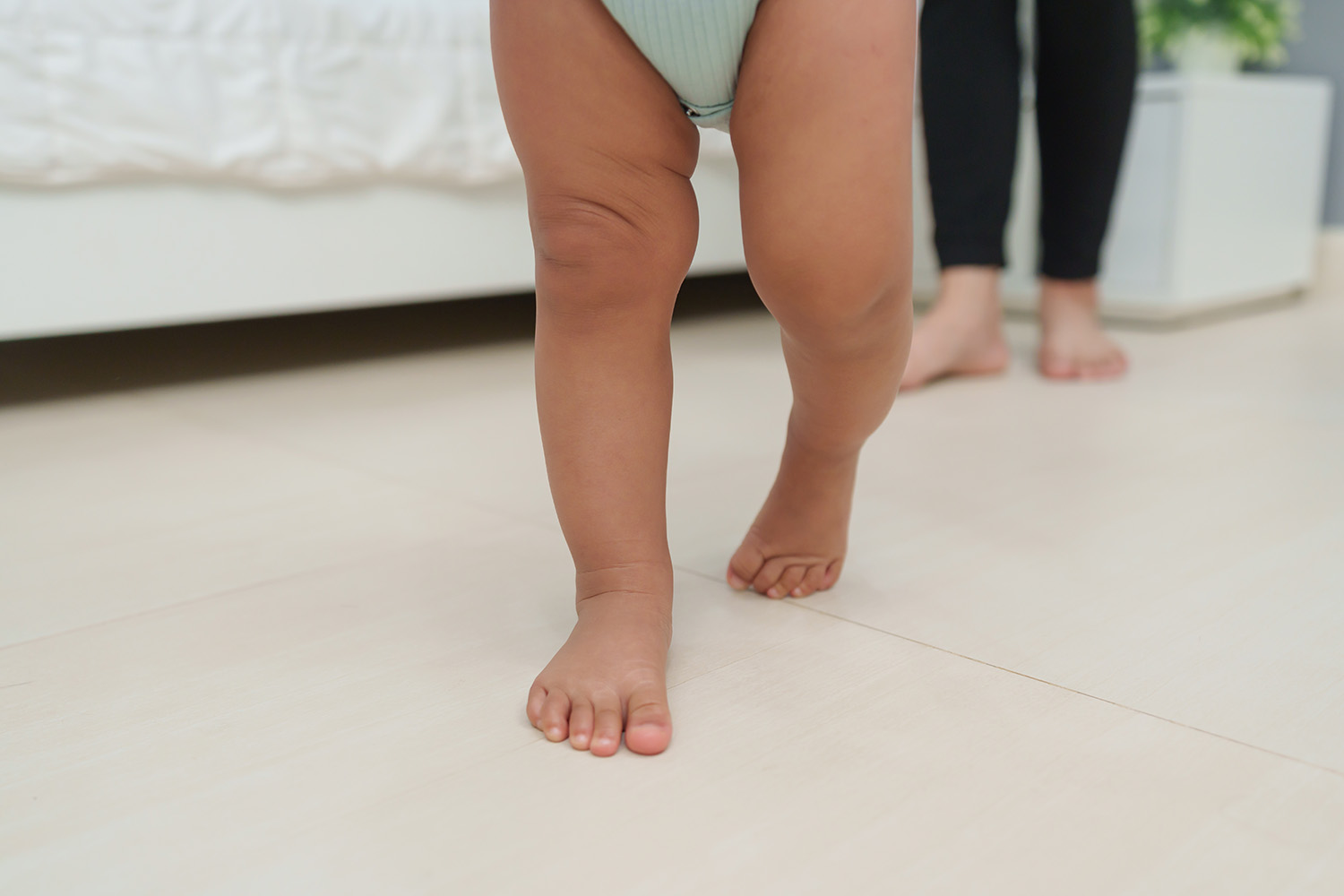
Assistant Professor Kari Kretch uses wearable sensors to understand how children with Down syndrome learn to walk, aiming to improve outcomes throughout their lives.
BY KATHARINE GAMMON
WHEN A CHILD TAKES A STEP, it can feel like a miracle — especially when that child has developmental delays. A new National Institutes of Health (NIH) grant awarded in July will help the Learning, Development, and Rehabilitation Lab study how many steps infants and toddlers with Down syndrome take in their everyday lives. The project, “Measuring real-world stepping and walking performance in infants and toddlers with Down syndrome,” focuses on validating wearable step-counting sensors in natural environments — a first step toward understanding how daily movement relates to the development of walking.
Lab Director and Assistant Professor Kari Kretch is both a developmental psychologist and physical therapist. Her doctoral research examined how motor experience shapes typical infant development. After earning her doctorate, she trained as a physical therapist to apply that research to clinical questions. Working in early intervention, she treated children under age 3, including children with Down syndrome who were learning to walk.
Counting Steps to Independence
Walking development for children with Down syndrome is typically delayed by about a year, Kretch said, though some children take nearly two years longer than their typically developing peers. Those delays can mean less access to opportunities for exploration, play and participation in daily life. In short, walking is a pathway to exploration. “In the meantime, they’re sort of missing a lot of opportunities for interaction and exploration and play and participation,” she said.
The new grant addresses a gap in what researchers know about children’s mobility. Kretch distinguishes between walking “capacity” — what a child can do under optimal conditions or in a clinical setting — and “performance,” what the child actually does in daily life. While standardized tests can assess capacity, the team has far less information about everyday walking and stepping.
“This grant will really solidify the method of measuring step counts in this population,” Kretch said. She and her research team will test whether sensors can accurately measure step counts and whether those counts are clinically meaningful indicators of walking ability.
A longer-term research question is how the real-world stepping experience supports development. Once the measurement method is established, researchers hope to learn whether children who reeive more supported stepping practice begin walking independently sooner and whether children who take more steps after learning to walk improve their skills more quickly.
Research Starting in the Real World
Kretch said the work could ultimately inform interventions that support children’s development and participation. Her lab is developing and assessing the feasibility of an intervention aimed at increasing stepping activity at home and in the community among pre-walking infants with Down syndrome. The broader goal, she said, is to use foundational research on development to shape interventions and eventually test them in clinical trials.
At USC, where she established her lab in 2024, Kretch has drawn on existing collaborations and relationships with local families and communities to launch the research. Rather than starting in the lab and later moving experiments into more naturalistic settings, her her uses a flipped approach: It begins by observing what children experience in everyday settings and then uses those observations to guide controlled studies.
“We’re starting with what the real-world activity looks like,” Kretch said, “and then using that to inform the types of experiments that we might want to do with a child who is learning.”